Wednesday, April 28, 2010

Wiggle Your Waggles Away

After reading Teacher Tom's post about movement in preschool I started thinking about how much movement kids are do at home. I'm thinking that kids with bigger houses than mine have playrooms where they can move. Or a yard on the same level as the rest of the house. They don't need to do most of their moving inside, in the main living space, but mine do. After all, I live in Seattle, where it is often too cold and rainy to venture out (for me, not for them). So we play on the furniture.
I know many parents have rules about the furniture and enforce them well, but I am not one of those parents. The only rule I can consistently enforce is "No feet on the table". Everything else is up for grabs. My kids jump on every piece of furniture I own. When they want a snack out of the cupboards they get a stool and climb up on the counter. Yep. Icky dirty feet on the counter.

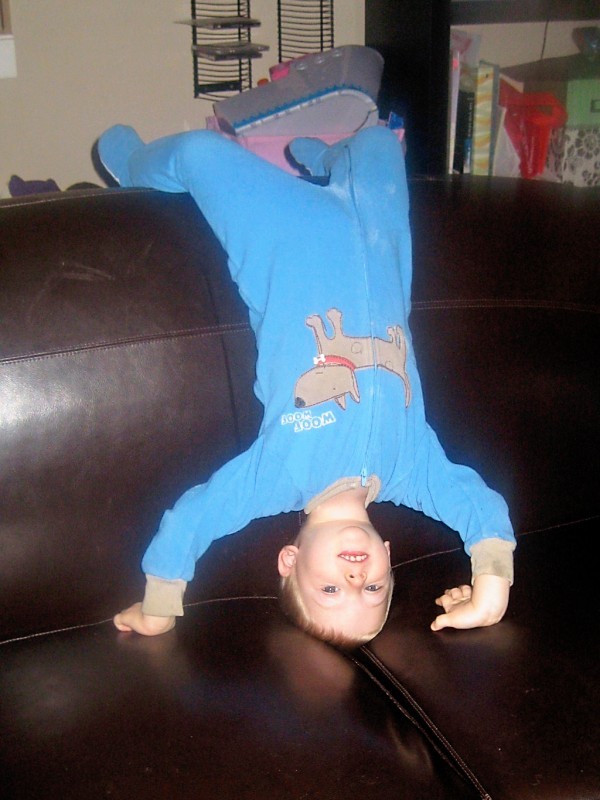
They regularly watch TV upside-down on the back of the sofa. This looks like a wonderful back stretch, doesn't it? Beds are for jumping on in our house. Sleep is just for those too tired to jump.
The stairs are rolling, sliding and bumping down. Often face first. Even when they were very little.
I know. You're horrified. I am a permissive mother. Although my kids have regular bumps and bruises, they've never had broken limbs, concussions, or stitches. Not a single one. In fact, they may be less likely to get seriously injured because they have so much practice time with balancing, shifting weight, and judging their own strength. I watch them carefully, of course, but I never, ever ask them to sit still. Those wiggles are not just going to go away on their own, I figure.

Friday, March 26, 2010

Wondertime, I Miss You


The March issue of Family Fun magazine just arrived so I'm sitting here ripping out all the pages that have ads on both sides. While I understand the necessity of advertising revenue, the shameless self-promotion of Disney Inc really pisses me off. The rrriiiiippp as I tear out the pages advertising the Disney channel's new family comedy or Disney Cruise Line or Disney Mobile Magic ("Put the magic of Disney Parks at your fingertips!") is so satisfying. The ads for ADHD meds (the highest grossing market for child pharmaceuticals) are another pet peeve. Rrrriiiippp. Soon I have pared it down to a few extremely ugly "craft" ideas and one or two "helpful hints" for moms.
I never signed up to receive Family Fun magazine. I had a subscription to Wondertime, another magazine owned by Disney, which met its tragic demise when the economy took a downturn last year. My subscription was automatically changed to Family Fun. The infinite superiority of Wondertime was immediately obvious. Not only were their crafts beautiful, their big, colorful photos and long, thoughtful articles always engaged me. The recipes were delicious. Their frequent contributor, the hilarious Catherine Newman, is one of my favorite mommy bloggers. I read each issue from cover to cover and laughed and cried and felt empowered.
Obviously, that is the kind of thing Disney abhors.
Otherwise my beloved Wondertime would still exist. Disney, why must you crush everything that is beautiful?

Wednesday, March 3, 2010

The Chore Chart

This is "from the archive": my idea for how to avoid nagging your kids about what they need to do and actually make it fun.

Rewarding 3-5 Year-Olds for Good Behavior
(P.S. It’s not bribery!

Bribery is a crime. It happens when someone offers something so enticing, so desirable that saying no just isn’t possible. Ten thousand dollars to lie about someone’s whereabouts. A pony if you tell me where you put my keys. See, it’s not possible to say no, especially when the requested behavior is so easy to do. Bribery is not a policy I condone. So when I tell you to reward your preschooler for good behavior, that’s exactly what I mean—a small token of your appreciation for accomplishing something that’s a little bit hard to do. You know, those things kids are supposed to be doing by themselves every day, but sometimes don’t.
The chore chart is a simple way to create a positive interaction. After all, those preschoolers are just too busy playing, exploring and building to stop and do something as mundane as putting their toys away. Even if you remind them a million times, it may not get done.
The goal with the chore chart is to get the behavior you want without the whining and foot-dragging you don’t. After using this technique for just a week, my daughter started clearing her dishes from the table after every meal without being reminded. She even did it when we forgot to do the chore chart.
Your child, like almost every mammal, can be trained to respond to positive reinforcement. Eventually, you drop the rewards, but the good behavior continues because it is now routine.
For preschoolers, these behavioral inducements should be something fun, small, and temporary. My local toy store has a wall of trinkets for $1 to $2. I pay an average of five bucks a week for whine-free, blissful tooth-brushing, dish-clearing, and room-cleaning.
So here’s how it works:
1.Make a chart or list of jobs the child needs to do to earn the reward. The number of jobs to do is the same as the child’s age, ie. 3 jobs for a 3 year, 4 for a four-year old, etc. Write a short phrase or word and put a picture next to it, then laminate (see directions below for easy laminated wall chart). Using an erasable marker, kids get to cross out each job as it is completed. Visit www.trendenterprises.com for markers.
2.Always make it clear what the reward will be. It can still be a surprise, as long as the child understands the scale of the surprise: I’ve got something in this envelope for you when you finish your jobs.
3.Be positive. Praise the child for what she has accomplished toward the goal instead of nagging about what she hasn’t done.
4.Don’t sweat it. If your child forgets to do a chore or chooses not to, don’t worry about it. The opportunity to remind your child why he needs to do the chore will arise, and you can use positive language to do it. You didn’t do all your jobs today so you don’t get a surprise tonight, but I bet you will do a better job of remembering tomorrow.
Three- to five-year- olds love to be independent. By remembering to do the chart herself, your child already feels positively rewarded. You can up the ante by having her show you the completed chart (and reacting appropriately) or gathering the family around to see her get her reward. That kind of public recognition is something you never get with bribery. It’s so… secret. Your child’s good behavior, on the other hand, should be shared with everyone.

Easy laminated wall chart:
1.Take a 8 ½ x 11 sheet of paper or card stock and draw or paste on pictures to represent what your child needs to do.
2.Write a short phrase next to each picture, like brush teeth, comb hair, or make bed.
3.Starting at the bottom of the page, put a strip of shiny cello-tape across the paper. Firmly press the tape in place.
4.Place another strip of tape above this one, overlapping slightly, and press it firmly in place.
5.Repeat the process all the way to the top of the page.
6.Hang on the wall using a thumbtack.
Monday, February 15, 2010

"Read it Again, Mommy!"

As an avid internet shopper, I try to grab good deals wherever I see them. So when I saw Children Just like Me on Amazon for one cent (plus shipping) I instantly bought it. It was used and published back in 1995, but I felt sure it would soon be a household favorite. When my five-year-old saw the cover she was less than intrigued. She said "oh" in that way you do when a package comes in the mail and doesn't contain chocolate or clothes.

Over the next couple of days I would pick up the book and sit on the couch, thumbing through it. Today, my daughter came over and sat next to me. As I felt her peer over my shoulder, I just began reading. In the book, each child from a geographically distinct part of the world has a full page profile with detailed color photos of their family, home, school, toys, food, and more. The kids talk about these things in their own words. Cora was soon hooked. We read about kids from South America, Alaska, and Eastern Europe. Tomorrow it will be Africa and Asia, Australia and Western Europe.

Although it is tempting to just buy popular TV characters and fad book series, I find that after reading those books once or twice, my kids have lost interest. The books usually lack originality and, often, substance. They teach a simple lesson or new vocabulary words. Once these things are learned, the books cease to have value. That doesn't mean I don't buy these books or appreciate them as gifts-- I do, but I know they are not going to be favorites. What I really look for now is a book that touches on something so huge, so abstract that the kids get something new out of it each time they read it. Sometimes these books are slow to catch on. If the kids don't seem interested at first, I just keep trying. (This is also why I can't get these books from the library. They can't sit around waiting for our attention for six months!)

Children Just Like Me seems to capture a certain message about childhood without preaching about it, which is why it is so addictive. In the same way, I hope my other recent purchases will help give my children some perspective. I bought James Herriot's Treasury for Children and Laura Ingalls Wilder's Little House in the Big Woods. I'm also awaiting the arrival of Material World: A Global Family Portrait, a series of photos of families and their belongings arranged outside their homes. I'll keep you posted on how those go. In the meantime, I will be answering the call of "Read it again, Mommy!" with glee.

Wednesday, January 27, 2010

Co-op Moms: The Sisterhood

Last week I got together with seven other moms from Cora's preschool. Although my daughter left the preschool eight months ago, the other moms and I still regularly communicate. We are still using the Yahoo groups listserv to send messages to all the families involved last year. Many of us are also Facebook friends. If your children go to a traditional school, this may sound strange to you. I didn't really understand how different co-op preschools were until I overheard some moms talking outside our children's kindergarten room. One asked the other who her child was. A few moments later they realized they had been in the same preschool class the previous year. For me to not recognize a parent from Cora's preschool I would have to be unconscious. In the course of one short year we became extended family. These other moms became my sisters.

How did it happen? The co-op preschool model is unique in that, in exchange for the parent's time and effort, we get some of the best preschool education around. Plus, the tuition is incredibly cheap. Parents must stay with their child at school one day each week. During that stay they man a station and help the kids in that area. They must also fulfill a "job" such a treasurer, or secretary. They attend required monthly meetings in which a parent educator paid by the sponsoring college or university teaches them about (surprise!) parenting. The school's business is also done at these meetings.

As we all know, parenting is a difficult business. The support I received from the co-op families last year was better than therapy. Seeing other moms and dads going through the exact same issues was so comforting. Over the course of the year, many struggles brought us closer. One mom went through a nasty divorce. Another lost her father. Triumphs like the births of two babies gave us cause to celebrate. Because we all depend on each other to make the co-op work, any issue like this always meant we had to pull together to bridge the gap. We gave rides, babysat, covered each-other's school duties and cooked meals. We supported our fantastic teacher, Lauren, and in return she gave our children a loving, nurturing environment.

Even though our children are at nine different schools this year, our history with the kids makes us still feel close. At drinks last week we laughed and laughed, commiserating over the new year's struggles, celebrating each child's latest triumph. Looking back, I couldn't imagine a better way to take my children (or myself) through the preschool years.

Thursday, January 21, 2010

Telling the Truth

Like many parents, I try to tell the truth to my kids when they ask a question. Sometimes that means explaining something I'm not mentally prepared to explain. Like when my daughter pointed to the condom machine in the truck stop restroom and asked, "What's that?" Thank goodness I got to practice (and observe) some of the more important conversations in the parent education courses I take.

As part of the co-operative preschool model, all the families enrolled in the system take monthly classes led by experts in child development and parenting. Unlike, oh, I don't know, Jo Frost (Supernanny) they all have children themselves. Whatever situation you ask them about, they've usually been there. From these great educators, and special guests like Amy Lang, I'm learning how to answer questions like the one my daughter posed. First, I gave simple, short answers that related to things she already knew. I tried to stay calm and listen to what she was really asking. Here's how it went:

Cora: Mom, what's that?
Me: A condom machine. It sells condoms.
Cora: What's a condom?
Me: A piece of plastic that stops someone from getting pregnant.
Cora: Where does it go?
Me: Over the penis.
Cora: Oh.
Me: Did that answer your question?
Cora: Yeah.

Whew. We made it. She could have asked me lots of other questions. But she didn't. At five years old she just wasn't making the connections that we do. Since we already talked about how babies are made, I wasn't leaving her hanging there, I hope. Of course, this was just a small piece of the ongoing conversation about sex. Just like our conversations about war, religion, race, and hundred other topics. As of now, I still vow to tell the truth about those things too. Just not Santa or the tooth fairy.

Monday, January 4, 2010

Such a Person

"He's such a boy." Every time I hear these words I am filled with anger. Since my son first began to move around on his own, people have said this to me, usually when he is being aggressive or destructive. I never know how to respond. A dozen biting remarks leap to my tongue, but I don't utter them. I know it is more important that I never think that way about him.

Now that he is two and a half, he picks up on most things people say to him. Before long, I think, he'll be wondering what this little phrase means. And that is the most agonizing of all. He shouldn't have to wonder what it means to be a boy. He should just get to Be.

My son has always been a sweet, loving person. He hugs and kisses without restraint, he says "I love you" "You're my best friend," to everyone he is enjoying playing with. He says sorry with genuine remorse and is brought to tears when his sister is in pain.

This kid is also obsessed with anything that has wheels. In the stroller he leans over the side to watch the wheels go around. He does the same to his play cars, and with such seriousness you would think he were an engineer. He also likes to dress up in his sister's princess dress and serve tea. His dad and I encourage him in all these things, because they seem to be good for him. He is a happy child, and that's all that matters to us.

Parent Map recently published an article citing two doctors (and their extensive research) who seem to agree. They say nurture, more than nature, determines gender-specific behavior. According to the article's author,
Boys and girls are different at birth – but those
differences are much smaller than you may think.
It’s how babies are treated that sets them on the
path toward more gender-typical behavior, magni-
fying those small differences until we become the
monster-truck/chick-flick stereotypes of adulthood.

My concern for my son is that he not feel forced into a self-image that doesn't suit him. We see the long-term psychological effects of poor self-image all around us-- in eating disorders, depression, and self-destructive behavior, to name just a few. I don't mean to be overly dramatic, but I think the less my son has to think about whether he is behaving like a boy or not, the better.

So anyone with a great idea of how to politely but effectively respond to the comment, "he's such a boy," I'd love to hear it. Or any other thoughts you have on the subject of gender, let me know.

Thursday, December 31, 2009

Best Ideas for 2010

Call them resolutions or a wish list, these are the things that have been tickling the edge of my consciousness the last couple months. Will they become part of my life this year? I don't know, but I hope at least one of them becomes part of yours.

The Washing Line.
You know in movies set out in the country or in the distant past, women are out hanging clothes to dry on a washing line. The sun is beaming down, the shadows play across the surface of bright white sheets--that may be a Downy commercial, actually. Anyway, drying clothes on the washing line has this old world quality to it. Plus it saves energy. I know my dryer runs almost all day when I am doing several loads of laundry and if I could cut that energy use down, I'd be happier.
Here's the catch-- my neighbors will never go for it. And I'm pretty sure my landlord will tell me I can't put one up. But if we just start talking about washing lines, how great they are, maybe our neighbors and landlords will come around.
My in-laws in England dry almost all their clothes on a washing line and their clothes look amazing. Shirts that they have had for years look practically brand new. I think the dryer really wears out the fabric quickly. So think about that.

The Fondue Pot.
Is there any snack more delicious than sweet things dipped in melted chocolate? Yes. Savory things dipped in melted cheese. You don't really even need the pot. Just make the fondue, put it in a microwaveable bowl, break out the toothpicks, and serve.

Chocolate Fondue
1 cup semisweet chocolate chips
1/2 cup half-and-half
1 teaspoon vanilla
Fruit, pound cake, angel food cake, or marshmallows for dipping

Cheese Fondue
1 cup milk
1 pound Monterey Jack cheese, grated
2 tablespoons flour
1 t salt
Ham, sausages, potatoes, tortellini, veggies for dipping

You have your choice. You have your recipes. Let the yummification begin.

Amnesty International.
I joined this group back in college and was a fervent supporter for years. I really liked being able to directly help people who really needed it. I wrote letters on behalf of wrongly imprisoned folks-- peaceful protesters and such-- and asked their governments to give them a fair trial or let them go. Usually it worked, not because of my letter alone, but because thousands of people from all over the world had written. It felt really good.
Amnesty has dropped off my map lately, though, and I mean to do something about it. A few airmail envelopes from the post office and a little research on their website and I will be back in the hell-raising saddle. Yee-haw.

Sunday, December 13, 2009

A Bit of Christmas Whimsy

Last night, as the clouds rolled in and dusk prevailed, we finished up an early supper and got bundled up for a much-needed bit of exercise. Jim had heard there would be lights and caroling, hot drinks, and merriment along the path at Greenlake. We parked by the community center and set off on the very crowded path. People and dogs were holding and sometimes wearing strings of lights. The path was lit on either side by simple luminaries in white paper bags. My two-year old walked up to the first light on the right side of the path, stopped and bent down to look at the candle. We walked a few steps to the next luminary and he stopped again. He repeated the process for about the next 15 lights, establishing the fact of their sameness. I laughed and walked slowly on with him, content to let him satisfy that need. My five-year old charged ahead, as she likes to do, eager to see what was coming up next.

As we moved away from the lit parking lot, it got very dark. The huge evergreens in the park blocked the light from the street and most of the noise. The lake was quiet and still, a thin crust of ice over the top. Yet the path was filled with people, their anonymous forms filling the space between the lake and the trees with human sound. After about half a mile we came to a group of carolers and stopped to listen. The air was crisp and cool and the lights of the houses across the lake spread straight over the water's surface like drips of paint. The songs ended and we applauded in our mittens and gloves. I marveled how, in this place filled with strangers (and possibly friends, who would know?) we gained a new holiday tradition and breathed in just a bit of the whimsy that makes Christmas so special to me.

Sunday, December 6, 2009

Think Like a Man, Part 2

As you may know, I have challenged my female readers to "think like a man". Not because men are superior to women, but because I think some female ways of thinking are damaging to our selves: putting others first, expecting others to know when you need to be rescued, etc. Part of this may be biological necessity, but I think part of it is rooted in our American culture.

Look at stories like Cinderella, Snow White, and Sleeping Beauty. In Disney versions of these stories, the female main character is a passive, helpless thing, relying on others to not only help her, but tell her what to do and when to do it. A girl entrenched in these stories as an adolescent gets a very clear message: you must wait to be rescued. If your life is empty, if cleaning up someone else's mess all day is less than fulfilling, wait, and your prince will come.

Now I know some people will say Disney movies have changed. Today's princess hero is nothing like that. Ariel, of Little Mermaid fame, goes after her chosen man, after all. She is proactive and assertive, they say. But she is still pinning all her hopes for happiness on a man! She is willing is give up everything to marry a man she barely knows. How many young women have taken this lesson to heart, only to find out ten years down the road that the romantic ideal they were chasing was just a fantasy? They are still not fulfilled.

In order for women to start "thinking like men", they must stop waiting for their prince to come. I want my daughter to seek out what makes her happy, to explore all the possibilities of what her life could be, then choose the best possible path for her. I hope she never gets the Disney message, a cultural diatribe written in pretty sparkly letters. Yet there is another message out there, rising up over the horizon, that tells girls "think for yourself". And I think if all of us, working together, can make this as loud as the other is pretty, the message will come across.

How did you teach your daughter to think for herself?

Wednesday, December 2, 2009

The Blog Effect

About once a week I like to hop over to typepad.com and read Soule Mama, a blog by a mom who knits, sews, and home-schools her four children with grace and ease (or at least that is how it seems). Usually I feel peaceful, calm and inspired by her photos or posts. But last week I found myself weeping as I viewed her tribute to her youngest child on her first birthday. The photos of the gifts from the siblings, made with such love and care and beauty, made me so sad. I had long envied Soule Mama, but now the startling evidence of her seemingly superior lifestyle was right there in front of me.

Suddenly my life felt hectic, ugly, and completely at odds with my values. While my kids were stuck inside watching TV, hers had been out gathering wood to make blocks and knitting balls for the baby to play with. I can't even imagine the horror on my kids' faces if they got these gifts this month. My daughter dreams of a Playmobil box with hundreds of shiny plastic parts under the Christmas tree. Both kids fall asleep to the sound of traffic on the busy road just beyond our door. That morning I read her post, Soule Mama made me seriously doubt my earlier contention that life in the city is better in the long run than what I had growing up.

Although a blog empowers us by letting us share the real details of our lives, it may also be the great humbler. Reading blogs, I am now regularly reminded how unoriginal my ideas are and how different my life is from the many I have imagined for myself. That is not to say I am disappointed with my life, (my husband and children are amazing and wow me with their special gifts every day) I am only disappointed with my inability to be all I can imagine.

Wednesday, November 18, 2009

Cloth Napkins Could Save the Planet


Ok, maybe not all by themselves, but using cloth napkins helps a little. Today I took a load of them out of the dryer and wondered once again if I should keep using the older ones. My husband and I got them for wedding gifts: one pretty white cotton set and one rich gold set that matched our dishes. They both look pretty shabby now, and out of shame I did buy some maroon ones a couple years ago to use with guests. And my mother-in-law just gave me some pretty blue ones.

Yet I still can't bring myself to throw out the old ones. Every time I look at them I think about how much wood pulp we've saved by not using paper napkins. Who knows, there could be a whole tree out there not cut down because we wipe our mouths with these stained rags! All joking aside, I really have gotten a lot of use out of those 16 napkins. If you figure two uses a day, roughly 300 days a year, for 11 years, that's 6600 uses! So it's like not buying 6600 paper napkins. It takes a little work to wash, dry, and fold them, but that is the extent of the effort needed. I even have a small hamper in the kitchen to stuff the dirty ones in at the end of the meal because I am too lazy to take them to the upstairs hamper.

Then's there's the money we saved. I feel so smug walking down the paper goods aisle in the grocery store, watching those poor saps stuffing jumbo-size packages of Brawny into their carts. Now if I could just figure out a way to save on toilet paper...

Wednesday, October 14, 2009

Super Cinnamon Rolls

These super-fabulous breakfast treats are adapted from Bread Machine Magic, by Linda Rehberg and Lois Conway. This is the way to make them without a bread machine. The buttery-sweet glaze is far superior to the sticky, over-sweet frosting you usually get. I also added a touch of whole-wheat flour for a slightly more nutritious version. Makes 12 rolls.

For dough:
1/3 cup luke-warm milk
1/3 cup luke-warm water
1 1/2 teaspoons active dry yeast
1 egg (room temperature)
1 teaspoon salt
4 tablespoons butter (room temperature)
2 1/2 cups all-purpose flour
1/2 cup whole wheat flour
1/3 cup sugar

For glaze:
5 tablespoons melted butter
1/2 cup brown sugar

For filling:
2 tablespoons granulated sugar
1 tablespoon cinnamon
2 tablespoons brown sugar

Put milk and water in mixer. Add yeast and 1 cup of the flour. Stir and let sit for 2o minutes until foamy. Add egg, butter, and salt and mix thoroughly. Attach dough hook, then stir in the rest of the flour and sugar. Mix for 10 - 12 minutes. Put dough in a warmed, oiled bowl and cover tightly with plastic wrap. Let sit in warm room for 45 minutes to one hour. The dough should be high and doubled in size when ready.
Meanwhile, pour the melted butter into a 9x13-inch pan. Sprinkle the brown sugar evenly over the butter and set the pan aside. In a small bowl, mix the filling ingredients and set aside.
Turn the dough out onto a floured surface. With a rolling pin, roll the dough into a 9x18-inch rectangle. Melt 1 tablespoon of butter and brush over the dough. Sprinkle the filling ingredients over the dough next. Starting with the long edge, roll up the dough and pinch the seam to seal. With a knife, lightly mark roll in 12 even sections. Slide a long piece of dental floss under the roll and under the first mark. Pull the ends up and across each other on the mark to cut the roll. Place the rolls in the prepared pan, making 4 rows of 3.
Cover the rolls with a towel and let rise in a warm oven 30 minutes. Take out the rolls and preheat the oven to 350 degrees. Bake 25 to 30 minutes until golden brown. Remove from oven and immediately invert rolls onto a large platter or serving dish. It may take a few seconds for all the glaze to come off the pan. Let rolls cool at least 30 minutes before serving. Enjoy!

Sunday, October 11, 2009

Think Like a Man

Women think: If someone looks like they need help, you should jump in and help them.
Men think: If someone needs help they will ask for it.

Women think: If he really loves me he will know what I need without me having to ask.
Men think: If she wants my help she will ask for it.

In my classroom I always try to pair up boys and girls together for group work. They communicate better and get more done than same sex teams. I don't know why. It is just something I noticed. As friends, co-workers and classmates, men and women work well together. But when they move in together, get married, etc, something strange happens. Women start expecting their men to act like women. They think: this person is my partner and most intimate friend. I expect him to act like all the close friends I have had in my life (which were women). Although he may be the love of your life, he will never think like a woman.

Women tend to relate to each other by sharing joys and triumphs, likes and dislikes, failures and sorrow. Over the course of the relationship a woman will look for opportunities to offer her help to the other woman. This is the ultimate show of affection for a woman. When her best friend offers to take her out to lunch, sit and talk for an hour, or watch her kids for her, it is her way of saying how well she understands what her friend needs at that moment. Women come to expect this of their friends, so much so that they never have to ask for help.

Let me say that again. Women get used to NEVER having to ask for help from the people they love.

I won't pretend to know how men relate to each other. It seems very complicated, with many unwritten rules and mores. Kind of like cricket. But I understand how a man shows his respect and admiration for his friends. He does this by never offering to help. He believes his friend to be capable of handling the situation on his own. If the situation is drastic his friend may ask for help and he will gladly give it.

Of course, you see where I'm going with this, but let me lay it out for you anyway. The woman, valuing her husband as her beloved best friend, either offers to help him or waits for help to be offered. In the first instance, she is disrespecting her husband by suggesting he cannot handle the situation. He is too dumb, lazy, incompetent, or in some other way incapable of handling the situation so she needs to jump in and save him.

In the second instance, she is stupidly waiting for help that will never be offered. The only way for the woman to get the help she wants is to ask for it directly. She should think like a man! Or at least remember that her husband loves and respects her enough to NOT offer his help. Yep. Strange though it may seem, those are the rules on his planet.

Saturday, September 12, 2009

Fries, Anyone?

I recently finished reading Michael Pollan's 2001 nonfiction work, The Botany of Desire. In the last chapter Mr. Pollan drives out to a potato farm to see how conventional potatoes are grown. The farmer he interviews gives a detailed (and terrifying) list of the pesticides and herbicides needed to grow his perfect Russett Burbanks. I thought I'd compile the information here for my readers.

On one field, in a single growing season, the following are applied:
1. Soil fumigant (kills all microbial life in the soil)
2. Lexam, Sencor, or Eptam (an herbicide to kill weeds)
3. Thimet (an insecticide)
4. More herbicide
5. Ten weekly sprayings of chemical fertilizer
6. Bravo (a fungicide)
7. Monitor (a deadly chemical known to damage the human nervous system)
After Monitor has been sprayed, the farmer forbids anyone from entering the field for several days.

If, like me, this list is making you feel a little queasy, you may want to avoid McDonald's fries. They are made from Russett Burbanks grown on farms exactly like this one. So are Ore-Ida fries in the freezer section, and basically any fries from fast-food chains. The only way to be sure you are getting pesticide-free potatoes is to ask the farmer who planted them (like at a farmer's market) or buy certified organic.

If you have children, be especially cautious. Studies have shown that these kinds of chemicals show a far greater presence in children because their bodies are smaller. They are basically getting a much stronger dose of poisons. And because their brains are still growing, the herbicides, fungicides, and pesticides may interrupt or interfere with vital development.

Overall the conventional way of growing potatoes is not sustainable. It damages the earth and poses many health risks for people. By purchasing and demanding more organic options, you can hope your next order of fries is not served up with a side of poison.

Thursday, September 3, 2009

Julie and Jennifer

Ways I am Exactly Like Julie Powell
ie: Why I will soon be rich and famous

1. I like to cook. Julie Powell likes to cook.

2. I have a wonderful husband who tolerates my many eccentricities. Same for Julie.

3. I consider myself a wanna-be writer. So did Julie Powell.

4. Julie and I both have fat cats.
5. The blogging, of course.


Ways I am Nothing Like Julie Powell
ie: Why I will never be rich and famous
1. I do not live in New York City.

2. I have two small children who take up... my entire life.

3. I have no cool year-long project for readers to rally around.

4. I can't swear online. I just can't do it.

5. About a million more people are blogging now... so very limited chance that my blog will be singled out for any kind of... movie deal.


So there it is. My life as it stands in comparison to Julie Powell's life. Sad.

Eleven Years and Counting

So here I am on a Thursday night wandering around the house looking for something to do besides go to sleep. My kids fell asleep about two hours ago. So did my husband. He didn't turn in early because he was tired. He didn't fall asleep on the couch watching TV as I've heard some spouses do. He fell asleep putting our daughter to bed. This happens about once a week so I really should be used to it. I should relish having a quiet house in which to read a book or, say, write a blog post, but I don't. I'm annoyed that I'm missing out on time alone with my husband.

It wouldn't really matter to me if we just watched Seinfeld re-runs and didn't even talk. I just want to have a shared experience. This is a fundamental difference between men and women. To Jim, falling asleep at nine pm is funny and kind of nice. Boy, I was tired, he'll say tomorrow, grinning. He'll tell me how he woke up and put his pajamas on at two am. Then he'll go on with his day.

Now ladies, I know you're thinking that tomorrow I should kick up a fuss over the whole thing. I should pout around the house until he asks me what's wrong, or go straight in and begin the complaining how he never spends enough time with me, etc. But let me tell you, that is exactly the wrong thing to do.

After eleven years of marriage, I have realized that trying to make a man feel guilty for things he didn't think he did wrong in the first place doesn't work. It just creates this huge gap between you two. He wonders what you're on about. You wonder how he can be so daft. You start questioning the whole state of your marriage-- over an early bed time.

What works with men is a direct request for their time and attention. This request must not contain any hidden guilt trips, secret pre-requisites, or dishonest statements. Tomorrow, when I see my husband again, I will simply ask to spend some time with him, which is all I really wanted in the first place.

Sunday, July 12, 2009

Country Mouse and City Mouse

When I moved to the city as a young woman I thought it was the best darn thing I'd ever done. Suddenly I had art, culture, society all around me. I love being in the midst of a pulsing, busy city like Seattle. Yet occassionally I find myself yearning for wide open spaces and the kind of interactions with nature you just can't get in the city. Particularly for my kids. And for my sanity. Did I mention the sanity? Trying to entertain, educate and inspire two young kids at home (or around town) every day is a test of anyone's mettle. First there's the constant lookout for dangers like traffic and broken glass. Then there's just trying to keep two kids happy at all times, doing the kind of play that won't make me look bad in front of strangers. Then there's just that nagging worry that some freak is gonna grab one of my kids and run off. Unlikely, I know, but you gotta think about these things. So basically I am hovering over or near my kids every minute we're out of the house.

Open-ended discovery play is what I experienced growing up. For all you non-educators, that means your parents opening the back door and saying, "There you go. Be back for dinner." Yep. Unsupervised outdoor play. At our home near Fortine, Montana, my brother and I made forts, harvested berries, hunted for bugs, watched birds, deer, squirrels, and all manner of creatures and never once worried that a "bad man" would suddenly appear from behind a tree. In the winter we went sledding, made snow forts, and ice skated. We rode our bikes (without helmets) up and down every road within a two-mile radius.

Man, we didn't know how good we had it. We were country mice all the way. Completely ignorant of most of the dangers in the world. Ignorant too of the cultural and social experiences our city-mouse counterparts were having. Not that our parents didn't do exceptionally well in providing enrichment activities for us, considering where we were. I had piano, swimming, and tennis lessons. My brother had guitar and Tae Kwon Do. In the summers we traveled to cities and saw art and culture all around us. We even got to Disneyland a few times. (Yes, Mickey Mouse is culture). I'll never forget when my mom made us drive hours away from my cousin's house to see a Van Gogh (the irises) in an art museum. I knew then that art was pretty darn important stuff.

But these experiences were few and far between. Mostly we spent a lot of time driving. A LOT. It took me and hour and a half on the bus to get to high school every morning. Going to shop for groceries, clothing, and anything else we needed more complicated than paper and string required a 60-mile drive to the nearest small city. The whole family made this drive every two weeks. Every summer we drove to California or Colorado to see family. While my father drove my brother and I listened to the same six cassette tapes over and over. Then we stared out the windows, watching the landscape pass by.

I remember the feeling of waiting for something to happen. Waiting for my life to start. There was so much time and so little to do. Perhaps this is a universal childhood feeling. Maybe those city kids with their heated pools and rock concerts were feeling just as bored as we were.

So will I save my children from malaise through the constant stimulus of city life? When people ask me what I like about the city I say it is the opportunities it provides. My kids have done so many things that I never did until I went to college. I hope that their broad, deep knowledge of the world helps to shape their personalities and interests in positive ways. I hope my little city mice can take the big bad world and make it cheese.

Monday, April 27, 2009

Rhubarb Rhapsody

In early spring in the Northwest, the only fresh, sweet, local fruit is rhubarb. I admit, I didn't have a single idea what to make with rhubarb when I bought it, but several terrific recipes soon came into my hands. I made them all, to rave reviews. Here there are:

Apple Rhubarb Pandowdy from Local Flavors by Deborah Madison (p. 307)
Uses last fall's apples from storage.

Rhubarb Tart with Orange Glaze from Gourmet, April 2009 (p.56)

Rhubarb Waffles with Rhubarb Sauce from Eating Well, June 2009 (p. 47)
I made them with pancakes and my fav. Bob's Red Mill Buttermilk Pancake Mix instead of waffles.

You can find the Gourmet and Eating Well websites online. The pandowdy recipe you need the book for, or I'll reprint it here if I get the chance. Enjoy!